Your students enter the room to find a crime scene. Someone stole their reading pillows! Now, you’ve hooked them, and you can use the mystery to teach them reading, math, science, and writing. Integration is a great way to engage your students! It will push them to learn new content and apply it to other parts of the curriculum. Find out more about how to set up an integrated mystery unit in your classroom.
Planning an Integrated Mystery Unit
**This post contains affiliate links and I will be compensated if you make a purchase after clicking on my links. I only recommend products that I use and love.
Two years ago before winter break, my team had a meeting with our principal. She told us that she wanted us to try something outside the box to get our students excited about learning. She wanted us to use integration to spread the learning across all subject areas. I loved the idea, but I was worried. How could we do this when we had so much content to cover before state testing?
I started thinking about the units we would be teaching after break – chemical tests in science, opinion writing, and making inferences in reading. What if we read mysteries and set up a crime scene in the classroom? I started planning and spent much of my winter break aligning our science curriculum with a unit on mysteries.
The more I planned, the more excited I became!
Let the Mystery Begin
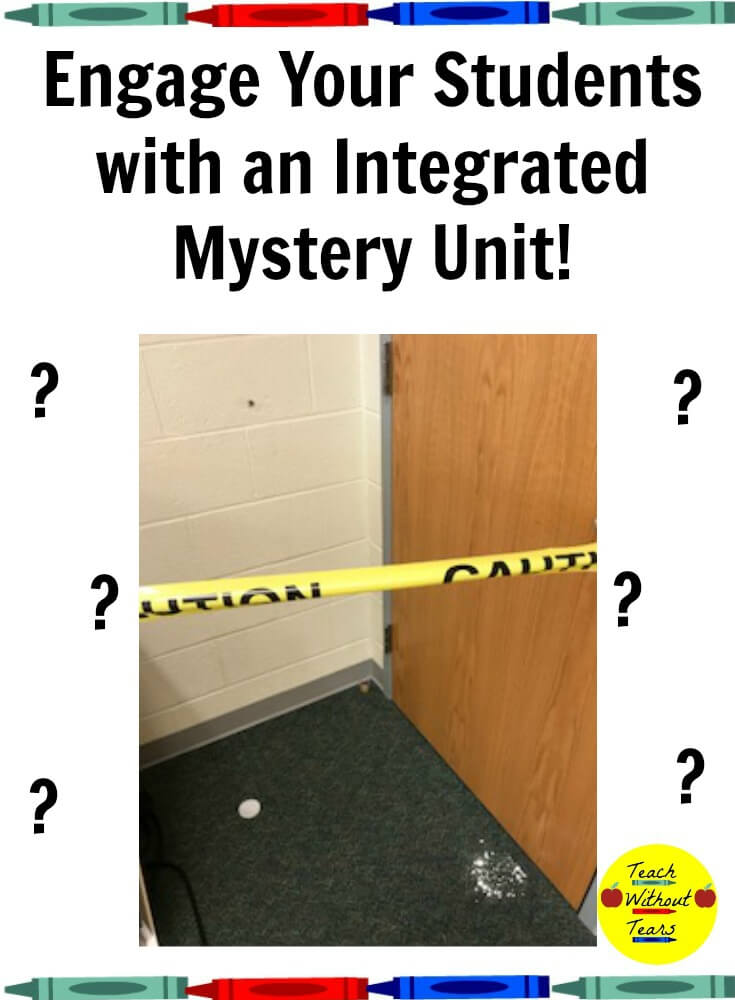
When my students returned from winter break, they found a crime scene in the back of our classroom. Crime scene tape blocked off the back corner where our reading pillows used to be. White powder covered the floor, and there were some other suspicious chemicals in the area. The culprit left a fingerprint on the wall.

There was immediately a buzz of excitement in my classroom as the students tried to figure out what happened. That excitement lasted the full 2 weeks of the integrated mystery unit.
Integration
We spent a large part of our days working on solving the mystery. Here is how we continued our regular curriculum while still working on the mystery.
Math
Math is one area where we couldn’t take a whole lot of time for special mystery activities. The day we returned from break, we kicked off the mystery with an Unlock the Box Mystery. We needed to review division, so rather than doing the regular paper and pencil review, we had fun solving clues to unlock the mystery box. Inside, the students found lanyards with FBI badges to show that they were the detectives who needed to solve the mystery.

The rest of the days, we had to continue with our regular guided math lessons, but I found a few extra mystery activities to work into our problem solving center.
Science
We were in the middle of a unit on chemical tests in science. I decided to use the chemicals as evidence in the crime scene. The students learned to use vinegar, iodine, and other chemicals to determine the identity of unknown powders. They would be able to do the experiments to find out what the culprit left in the crime scene.
We also analyzed fingerprints and handwriting samples to learn the basics of forensic science.
Reading
Mystery books were the obvious choice for our reading instruction on making inferences. We learned about the elements of a mystery and found them in the books. Then, we applied them to our mystery.
The students had reading partners to discuss their mystery books and a detective’s notebook to write about the mystery elements they discovered. They loved looking for clues and making predictions about how the mystery would be solved.
Writing
After winter break, we had a few days before the end of the quarter. The students wrote their own mysteries. We also started an introduction to opinion writing at the end of the integrated mystery unit. The students had to write an opinion piece explaining who they thought the culprit was and give evidence to support their opinion.
Solving the Mystery
As detectives, the students had a lot of hard work to do to solve the mystery
- Observe the crime scene
- Make a suspect list
- Write interview questions
- Conduct interviews of the suspects
- Analyze the crime scene evidence
- Create a timeline of events
- Make inferences about who was the top suspect and back it up with evidence
Through all of these activities, my students were using higher level thinking. Just our chemical tests unit and reading mysteries never led to this level of analysis. The kids were engaged, excited, and learning with this integrated mystery unit!
Do You Want to Try an Integrated Mystery Unit in Your Classroom?
Now, you can try my integrated mystery unit in your classroom! I’ve done all the planning for you.
Here’s what you’ll get:
- 2 weeks of plans for science and reading
- A checklist and detailed steps telling how to set everything up
- A detective’s notebook filled with everything your students will need
- Detective badges for your students
- The Division Unlock the Box Mystery
- Resources for integrating writing, technology, and more math
Check out this amazing Integrated Mystery Unit in the Teach Without Tears TPT Store!
You’re Invited!
Looking for ways to differentiate your lessons and meet the needs of all your students without adding more to your plate?
Join The Differentiation Conversation Community, a free community for elementary teachers where we share practical differentiation strategies, ready-to-use resources, and encouragement to help you meet the needs of all your learners.
What Do You Think?
How do you integrate all the subjects in your classroom?
Let me know in the comments below.
I would love to find more ways to do this, because the integrated mystery unit is now the favorite part of the school year for my students and me!
If you enjoyed this post and think your teacher friends will, too, please click the button to share it on your favorite social media platform.

Great read!
This sounds like fun. We should do this when we finish our novel study. I could get the other teachers in on it, too. Holly who teaches math & science could use those parts, Rabbi S who teaches ethics could do something related, and I’d handle the writing and reading. Sounds great. Thanks!
Is your division review enough on its own fir a mystery activity? I cannot deviate for other subjects, but I am thinking I could do a mystery to practice a math skill such as division.
Hi, Susan! The division review can be done separately. My students love reviewing math concepts with Unlock the Box Mysteries!
Sorry *for
What a fantastic idea! I love integrated and project-based learning.
Thanks, Amy! It’s a lot of fun each year!